New Feature: Employee Boarding Status Tracking for Better Pickup Visibility
Give transport teams a clearer view of employee pickups with boarding status updates. Track who has boarded, who is waiting, and which pickups are pending.
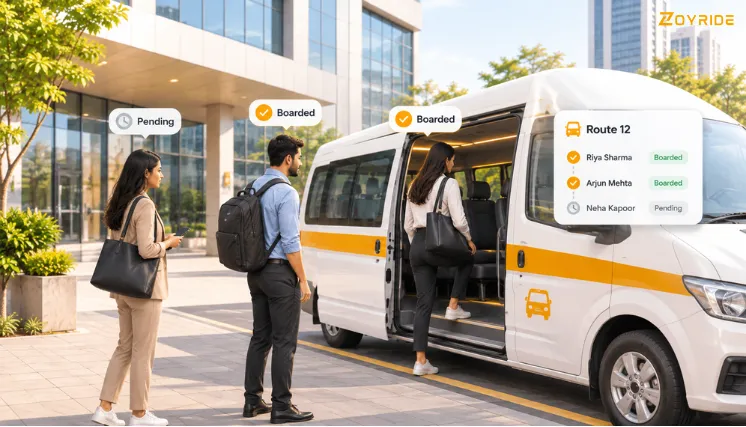
Quick answer: Employee boarding tracking shows, for each scheduled pickup, whether an employee has boarded the vehicle. It gives transport teams a clear status for every rider on every trip, so they can spot missed pickups early instead of finding out from a phone call.
A cab is parked at the pickup point. The driver waits a few minutes, then moves on. Twenty minutes later, an employee calls the transport desk to ask where the vehicle was. The driver says nobody showed up. The employee says they were standing there the whole time. Now the transport team has to work out what actually happened, with nothing to go on except two different stories.
This is one of the most common frustrations in corporate commuting, and it comes down to one missing piece of information: did this employee board, or not? Zoyride’s new Employee Boarding Status feature is built to answer that question for every pickup.
What Is Employee Boarding Status Tracking?
Employee boarding status tracking records whether each employee on a scheduled trip has boarded their vehicle. Instead of a trip being marked simply as “in progress” or “completed,” the team can see the status of each rider on it.
That improves employee pickup visibility. Operations teams, HR, and transport coordinators can see who has been picked up and who hasn’t, without calling drivers or asking employees to confirm by message.
The Problem: Pickups Happen Out of Sight
In most employee transport setups, the transport team can see that a vehicle is on its route. What they usually can’t see is what’s happening at each stop. The gaps this leaves are familiar:
- A driver marks an employee as a no-show, but the employee says they were there.
- An employee is waiting while the vehicle has already left, and nobody knows until they call.
- The team can’t tell, at the moment it matters, whether everyone expected on a trip is actually on board.
- Questions about who rode on a given day are answered from memory or from driver messages.
Each of these costs time, and the cost repeats every day across every route. Multiply a few queries a day by dozens of routes and the transport desk spends much of its time confirming facts instead of managing operations.
How Boarding Status Improves Pickup Visibility
A clear boarding status changes the questions the team can answer.
- Who has boarded this trip so far, and who is still waiting?
- Did the vehicle leave a stop with an employee still to be picked up?
- Which routes see the most missed pickups, and at which times?
- What happened on a disputed trip last Tuesday?
Having these answers in one place means the team responds to a missed pickup while it’s still happening, rather than reconstructing it afterward.
Who Benefits
Employee boarding tracking helps several groups, in different ways.
Transport coordinators get a live view of each trip, so they can step in early when a pickup looks like it has gone wrong. HR and admin teams get a reliable record for the questions they field: whether an employee used the transport, and whether a complaint matches what happened. Drivers benefit from a clear record too, which protects them from disputes over pickups that did happen. Employees benefit from a more dependable commute, since a missed pickup is more likely to be caught and fixed quickly.
Why It Matters for Safety and Accountability
For many companies, employee transport carries a duty of care, especially for early-morning and late-night shifts. Knowing that every expected employee has boarded, and being able to see when one hasn’t, is a basic part of running that responsibly.
A boarding record also supports accountability. When there is a question about a trip, the answer comes from a recorded status rather than competing accounts.
A Realistic Example
Consider a company running a 6:00 AM shift route with eight employees on a single vehicle. At the fifth stop, the driver waits briefly, doesn’t see the employee, and continues. Without boarding status, the transport desk finds out about the missed pickup when the employee calls, by which time the vehicle is well along its route and the employee is likely to be late.
With boarding status visible, the desk can see that one of the expected riders hasn’t boarded. It can contact the employee and the driver while the vehicle is still close, and decide whether to go back or arrange another option. The outcome depends on timing, and timing depends on visibility.
How to Get the Most From Boarding Data
The status on each trip is useful in the moment. Over time, the pattern is useful too.
- Look for stops with frequent missed pickups. They may have unclear pickup points or poor timing.
- Compare the employees expected on a route with those who actually board. Persistent gaps can show that a route is over-provisioned.
- Use boarding records to settle disputes quickly and fairly.
- Feed what you learn back into route and capacity planning.
Where This Fits in Your Employee Transport Software
Boarding status is one part of employee pickup tracking, and one part of running an employee commute well. It works best alongside the basics: route planning, live vehicle tracking, and clear reporting. Good employee transport software ties these together so the transport team works from one picture of the day instead of a collection of calls and spreadsheets.
Conclusion
Knowing where a vehicle is only tells part of the story. Knowing who is on it completes the picture. Employee boarding tracking closes the gap between a trip that is running and a trip that is actually carrying the right people.
For transport teams, that means fewer disputes, quicker responses to missed pickups, and a more dependable commute for employees.
Explore Zoyride’s Employee Transport Software and see how Employee Boarding Status gives your team clearer pickup visibility. →
Frequently Asked Questions
What is employee boarding status?
It’s a record of whether each employee on a scheduled trip has boarded the vehicle. It lets transport teams see the status of every rider, not just the status of the trip.
Why do companies need employee boarding tracking?
Without it, teams rely on driver reports and employee calls to know who has been picked up. Tracking gives a clear, shared record, which cuts down on disputes and lets the team react to missed pickups sooner.
How does boarding tracking improve pickup visibility?
It shows who has boarded and who is still waiting on each trip, so a missed pickup can be spotted while the vehicle is still nearby.
Is boarding tracking useful for night and early-morning shifts?
Yes. For shifts where employees travel at less sociable hours, knowing everyone expected has boarded is an important part of duty of care.
Does boarding tracking replace live vehicle tracking?
No. Live vehicle tracking shows where the vehicle is. Boarding status shows who is on it. They answer different questions and work well together.