How Enterprises Are Reducing Empty Seats in Employee Transport
Empty seats in corporate transport silently drain budget every day. Here’s how enterprises fix it — through better data, dynamic routing, and real-time occupancy tracking.
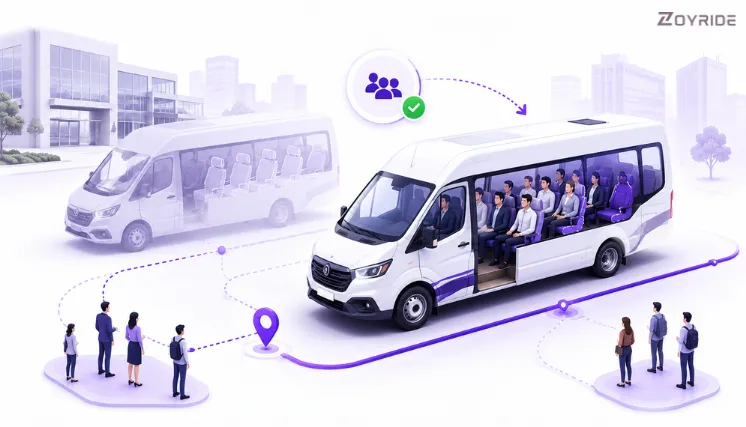
Empty seats may seem like a minor issue in employee transport, but over time, they can become a significant cost for enterprises.
A route may be planned for 12 employees, but only 7 actually travel. Shift changes, approved leave, hybrid work schedules, and outdated rosters often create a gap between planned demand and actual demand. As this happens across multiple routes and shifts, transport costs increase without delivering any additional value.
Leading enterprises are reducing these inefficiencies without cutting transport coverage. Instead, they’re using better data, smarter scheduling, and modern employee transport optimization strategies to make operations more efficient.
Here’s how they’re doing it.
Why Empty Seats Become a Cost Problem
Most employee transport routes are created using workforce information available at the time the routes are planned. But employee schedules rarely remain fixed.
Factors such as:
- Shift changes
- Planned leave
- Hybrid work schedules
- Employee relocation
can quickly make original route plans outdated.
As a result, vehicles often run below capacity. Since these inefficiencies are spread across multiple routes and shifts, they usually go unnoticed until transport costs begin to rise.
As transport costs increase, many organizations begin looking for better workforce transportation solutions that can adapt to changing employee demand.
Common Reasons Behind Low Seat Utilization
1. Static Rosters in Dynamic Operations
Employee attendance changes frequently, but route plans often don’t. This mismatch creates unnecessary empty seats.
2. Limited Visibility Into Occupancy
Without real-time utilization data, underused routes may continue operating for weeks before anyone notices the problem.
3. Fixed Vehicle Allocation
Many fleets are designed for peak demand and continue using the same vehicle sizes even when daily demand is lower.
1. Integrating HRMS Data With Transport Planning
One of the most effective ways enterprises improve employee transport optimization is by connecting HR systems with their employee transport management platform.
When shift updates, leave approvals, and employee information automatically sync with the transport platform, routes are planned based on actual workforce requirements instead of outdated data.
This helps:
- Reduce unnecessary vehicle allocation
- Improve route planning accuracy
- Minimize manual coordination between HR and transport teams
For organizations with large workforces, HRMS integration can significantly improve seat utilization within a short period.
2. Using Seat Booking to Confirm Demand
Many enterprises now encourage employees to confirm whether they need transport before vehicles are dispatched.
Seat booking transforms estimated demand into confirmed demand.
This enables transport teams to:
- Consolidate underutilized routes
- Avoid sending oversized vehicles
- Improve overall fleet efficiency
A simple confirmation process can make route planning much more accurate and reduce wasted capacity.
3. Tracking Utilization Trends Over Time
Daily reports only show what happened today. Long-term utilization data reveals patterns.
By monitoring seat occupancy across routes, shifts, and vehicle types, transport managers can identify:
- Consistently underutilized routes
- Low-demand days
- Hybrid work trends
- Opportunities for route optimization
Monitoring fleet utilization in employee transport helps organizations identify patterns that are difficult to detect through manual reports.
These insights help organizations make proactive decisions instead of reacting to isolated incidents.
4. Matching Vehicle Size to Actual Demand
Not every route requires the same type of vehicle.
Enterprises with mixed fleets can assign vehicles based on confirmed passenger demand rather than using the same vehicle size everywhere.
For example:
- High-demand routes may require larger vehicles
- Low-demand routes may operate more efficiently with smaller vehicles
This approach supports better corporate transport optimization by ensuring resources are aligned with actual employee demand.
It also helps reduce operating costs while maintaining employee convenience.
5. Adapting Routes for Hybrid and Shift-Based Workforces
Fixed routes don’t always work well for organizations with rotating shifts or hybrid work policies.
As employee attendance patterns change, transport plans must evolve as well.
Flexible planning has become increasingly important for office commute management, especially as hybrid work models continue to evolve.
Many enterprises now review routes regularly and use demand-based scheduling to:
- Adjust vehicle allocation
- Optimize pickup zones
- Improve route efficiency
- Reduce unnecessary trips
These adjustments also contribute to better employee shuttle optimization, particularly for enterprises operating multiple shifts.
This flexibility helps maintain service quality while improving utilization.
Where Should Enterprises Start?
Improving seat utilization doesn’t always require a complete overhaul.
Start by asking one simple question:
Do you know your current seat occupancy by route and shift?
If the answer is no, begin with visibility.
A practical approach:
- If rosters are updated manually, start with HRMS integration.
- If route performance isn’t visible, implement utilization reporting.
- If demand is unpredictable, introduce seat booking.
- If routes haven’t been reviewed recently, conduct a route utilization audit.
Small improvements often deliver meaningful results over time.
Final Thoughts
Empty seats are rarely caused by a lack of vehicles. More often, they’re caused by a lack of visibility.
When transport teams have access to real-time attendance data, seat booking information, and utilization reports, they can make smarter decisions without reducing employee coverage.
Small improvements in scheduling and planning can significantly improve seat utilization and lower unnecessary transport costs.
As workforce patterns continue to change, businesses that invest in smarter workforce transportation solutions will be better positioned to control costs while maintaining employee convenience.
Want to improve employee transport utilization without disrupting operations?
View a demo of Zoyride and see how dynamic scheduling, seat booking, and real-time fleet insights work together.
FAQ
Q1. What causes empty seats in employee transport?
Outdated rosters, shift changes, hybrid work schedules, and limited visibility into demand are some of the most common reasons.
Q2. What is considered a good seat utilization rate?
Many enterprises target 80–90% seat utilization, although the ideal percentage depends on workforce distribution and operating requirements.
Q3. Can seat booking actually reduce transport costs?
Yes. Confirmed demand helps operators consolidate routes and allocate vehicles more efficiently.
Q4. Why do hybrid work models create more empty seats?
Because employee attendance changes frequently, while fixed transport routes often remain unchanged.
Q5. How often should transport routes be reviewed?
Route performance should be reviewed regularly, especially when shift patterns, employee locations, or workforce size change.