What Happens Operationally When Trips Need Last-Minute Reassignment
Learn what happens operationally when trips need last minute reassignment and how dispatch software helps manage delays, driver changes, and service continuity.
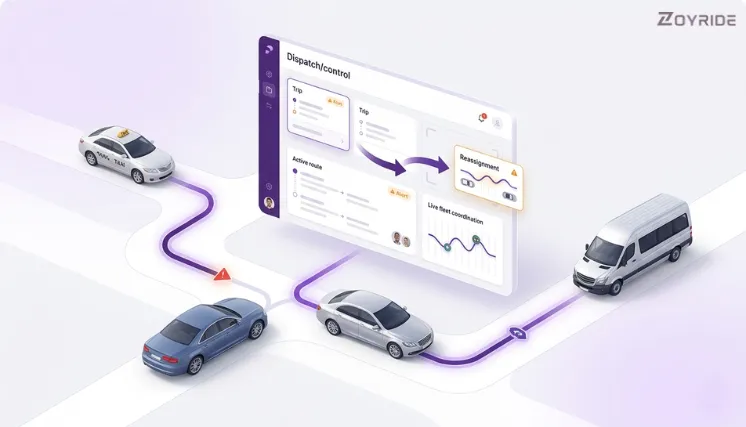
It’s 7:43 AM. A driver confirmed a pickup for 8:15. At 7:51, they cancel — vehicle breakdown, no warning. The passenger doesn’t know yet. The coordinator finds out from a WhatsApp message. The next available driver is 11 minutes away and already has a job queued.
What happens in the next 8 minutes determines whether the passenger makes their meeting, whether your SLA holds, and whether this becomes a one-off or a pattern nobody can see coming.
Last-minute trip reassignment is one of the most operationally disruptive events in fleet management — and one of the most common. Driver illness, vehicle faults, traffic delays, and no-shows trigger it daily across any fleet running at scale. How the operation handles it in those first few minutes is where service quality is either protected or lost.
Why Reassignment Is More Complex Than It Looks
When a trip needs last-minute reallocation, most people think about one question: which driver takes it? That’s actually the simplest part. The full operational picture involves several things happening simultaneously.
- The passenger needs to be notified. They’re expecting a specific driver. If the reassignment happens silently, they’ll wait at the pickup point for someone who isn’t coming — and call your office in a panic two minutes before the window closes.
- The new driver needs the full trip details instantly. Not a phone call from dispatch. Not a forwarded message. Passenger name, pickup address, special instructions, preferred route — all of it, in their app, before they’ve moved.
- The original driver’s queue needs adjusting. If the cancelling driver had chained jobs, those don’t disappear. The next trip in their queue is now unassigned too — one cancellation can cascade into three or four missed trips if nobody catches it.
- The coordinator needs visibility across all of this at once. In a manual operation, this means phone calls, WhatsApp messages, and a spreadsheet update — while the clock is running.
In a manual operation, the average time from driver cancellation to confirmed replacement is 4–8 minutes. In an automated dispatch system, it’s under 30 seconds.
The Four Points Where Reassignment Goes Wrong
1. Detection lag — finding out too late
In operations relying on phone-based driver communication, the coordinator often finds out about a cancellation after the driver has already left the zone — or when the passenger calls asking where their cab is. By that point, the reassignment window has narrowed significantly. The earlier a cancellation is flagged in the system, the more options the coordinator has.
2. Finding the right driver under time pressure
Not every available driver is the right reassignment option. The nearest driver may have a trip ending in 6 minutes. The second-nearest may be the right vehicle type but on a highway with no legal U-turn for 3 km. A driver further away might actually arrive faster based on live traffic. Coordinators making these calls manually are working with incomplete information under pressure — while simultaneously managing other active trips.
3. Communication gaps between all three parties
Once a new driver is identified, information needs to flow in both directions at once — passenger notified that a new driver is coming, new driver receiving the full trip details, coordinator confirming both have updated information. In manual operations, this is three separate actions. Any one can fail.
4. No record of what happened
After the trip completes, the reassignment typically goes undocumented. The original driver’s cancellation isn’t logged. The delay isn’t captured against the SLA. The passenger’s wait doesn’t appear in any report. The same driver cancels again the following week — and nobody connects the pattern.
Every unlogged cancellation is a data point you can’t use. Over time, those missing data points are the difference between managing your fleet and reacting to it.
How Automated Dispatch Changes the Reassignment Workflow
A well-configured taxi dispatch reassignment system compresses the entire manual workflow into seconds — and removes the human bottleneck from steps that don’t require human judgment.
- Automatic detection. When a driver cancels or goes offline, the trip is flagged immediately in the dashboard — no waiting for a WhatsApp message. The coordinator sees it the moment it happens.
- Instant reallocation logic. The dispatch reallocation system evaluates available drivers against proximity, current trip status, vehicle type, estimated travel time on live traffic, and driver rating simultaneously — surfacing the best reassignment option rather than leaving the coordinator to calculate it manually under pressure.
- Simultaneous communication. The new driver receives full trip details in their app the moment reassignment is confirmed. The passenger receives an updated notification with the new driver’s name, vehicle, and revised ETA. Both happen in one action — not two separate manual steps.
- Queue management. If the cancelling driver had chained jobs, the system flags those for reassignment too — preventing a single cancellation from cascading into multiple missed trips downstream.
- Audit trail. Every fleet trip reassignment is logged — driver, timestamp, delay duration, SLA impact, and final outcome. This is what turns a one-off incident into actionable pattern data.
What Reassignment Looks Like Across Different Fleet Types
Taxi and cab fleets
Speed is everything. A passenger who waits more than a few minutes beyond the expected pickup time is a dissatisfied passenger. The ride reassignment workflow needs to complete faster than the passenger’s patience runs out. Automated reassignment that confirms a new driver in under 30 seconds gives the fleet a genuine chance of holding the pickup window.
Employee transport operations
The employee’s shift start time is fixed. A late pickup doesn’t just inconvenience the passenger — it creates a downstream impact on a shift handover or a client meeting. Transport trip reassignment in employee transport needs to be fast and communicated. The employee needs to know a new vehicle is coming so they don’t call a personal cab and create a duplicate journey your operation still has to pay for.
Corporate and airport transfer fleets
High-value passengers with fixed time constraints — flight departures, hotel check-ins, meeting schedules. A last-minute trip reassignment here needs to surface the fastest available driver, not just the nearest one. And the passenger notification needs to land immediately — a driver calling from a personal mobile to say they’ll be 10 minutes late is not the same as an automated update with a tracked new ETA.
Reassignment speed requirements differ by fleet type — but the need for instant passenger notification and a full audit log is consistent across all of them.
The Pattern Data Most Operations Miss
One of the most valuable outputs of a properly logged dispatch reassignment system isn’t operational — it’s analytical.
When every driver cancellation is recorded, timestamped, and tagged to the driver and trip type, patterns emerge that are invisible in a manual operation:
- A driver cancelling 40% of bookings in the 7–9 AM slot is a scheduling problem, not a random event
- A specific pickup zone with a consistent 12-minute first-driver decline rate is a supply gap that can be addressed with zone incentives or pre-positioning
- A vehicle type with recurring mid-shift cancellations may signal a maintenance issue rather than a driver issue
Without the log, none of this is visible. With it, reassignment data becomes a continuous input into how the fleet is organised — not just a record of what went wrong.
Check Your Current Operation
If reassignment is currently handled manually or semi-manually in your fleet, these questions are worth asking:
- How long does it typically take from a driver cancellation to a confirmed replacement? If the answer is measured in minutes, there’s an operational gap.
- Does the passenger always receive a notification when their driver changes? If this depends on a coordinator remembering, it’s inconsistent.
- Are driver cancellations logged somewhere that feeds into performance reporting? If they’re only in WhatsApp threads, they’re invisible to your SLA data.
- Can your coordinator see all active reassignment situations simultaneously? If they’re managing across phone calls and separate tabs, the cognitive load is high and errors are likely.
Zoyride’s auto-dispatch and reassignment workflow addresses each of these points directly — from automatic detection and driver reallocation to simultaneous passenger notification and full audit logging. If last-minute reassignment is a recurring operational pressure in your fleet, it’s worth seeing how the system handles it under a real scenario.
See how Zoyride handles last-minute reassignment.
Automated reassignment, instant passenger notification, and full audit logging — built into your dispatch workflow.
Try it Free for 14 Days · Need help getting started? Contact our experts
Frequently Asked Questions
How quickly should a trip reassignment happen to avoid passenger impact?
Under 60 seconds is the benchmark. Beyond 2–3 minutes, passengers typically start making alternative arrangements. Automated systems complete reassignment in under 30 seconds — giving the fleet a genuine chance of holding the original pickup window.
What information does the new driver need instantly?
Full trip details — passenger name, contact number, exact pickup address, destination, and any special instructions. A pickup address alone isn’t enough. The complete trip record should land in the driver’s app the moment reassignment is confirmed.
Does reassignment affect the SLA for that trip?
Only if the passenger experiences a delay. A reassignment that still completes within the agreed window counts as on-time. A late pickup is logged against the original driver’s cancellation — not the replacement driver’s performance. Keeping these separated in the data is important for accurate reporting.
What happens to other trips in a cancelled driver’s queue?
In an automated dispatch reallocation system, queued trips are flagged immediately for reassignment. In a manual setup, this step often gets missed — a single cancellation silently affects three or four subsequent trips before anyone notices.
Can reassignment be triggered by something other than a driver cancelling?
Yes — vehicle breakdown, driver illness mid-shift, traffic making on-time arrival impossible, or a passenger changing their pickup location. Any of these should trigger the same ride reassignment workflow as a direct cancellation.