How Much Does It Cost to Run a Taxi Business in 2026?
Discover the estimated costs of running a taxi business in 2026, including fleet expenses, driver management, software, fuel, insurance, and operations.
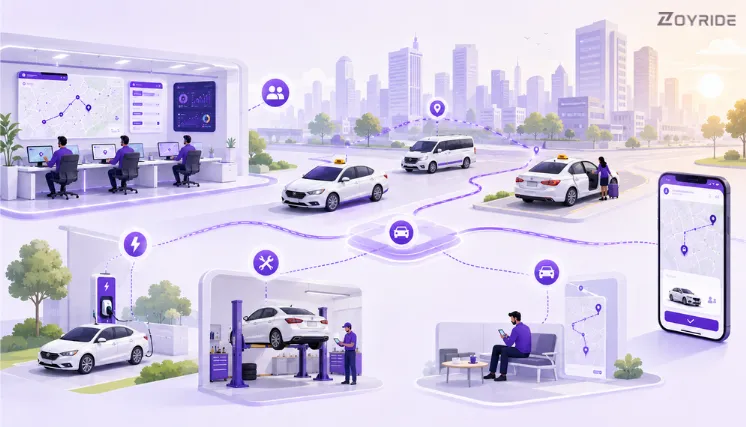
Most people starting a taxi business think about what they’ll earn. Experienced operators think about what it costs — because that’s the number that actually determines whether the business survives.
The cost to run a taxi business in 2026 is higher than it was five years ago, regardless of which market you operate in. Insurance premiums have risen. Fuel prices remain volatile. Driver pay expectations have shifted. And passengers now treat real-time tracking, booking apps, and instant confirmation as standard — not optional extras.
This guide breaks down the real costs — what you spend to start and what you spend to stay running. Rather than citing figures that apply only to one country, this is written for taxi operators globally. Where relevant, we use cost proportions and ratios that hold true across markets so you can apply the framework to your own numbers.
Absolute costs vary significantly by country, city, vehicle type, and employment model. Use the cost categories and proportions in this guide as a planning framework, then research specific rates for your market.
Starting Costs vs Running Costs — Understand the Difference First
These are two completely different financial questions and they need to be planned separately.
- Starting costs are one-time or upfront expenses — vehicles, licensing, permits, initial branding, and technology setup. These determine how much capital you need to open the business.
- Running costs are ongoing — fuel, insurance renewals, driver wages, maintenance, and software subscriptions. These determine whether the business is profitable month after month.
Most operators underestimate running costs. A business that launches successfully can still struggle if monthly expenses consistently outpace revenue without anyone tracking them closely.
Starting Costs: What You’ll Spend to Launch
Vehicles — your largest upfront investment
In most markets, vehicles represent 60–80% of total starting costs. Whether you buy new, buy used, or lease affects both your upfront cash requirement and your monthly running costs — leasing reduces the initial outlay but adds a fixed monthly payment to ongoing expenses.
The right vehicle type for your market — saloon, MPV, SUV, or electric — affects acquisition cost, insurance premium, fuel consumption, and passenger appeal. For most operators starting out, reliable used vehicles in the 3–6 year age range offer the best balance of acquisition cost and running economy.
Outfitting each vehicle
Beyond the vehicle itself, each cab needs meters, dispatch hardware, roof signs, decals, and any security equipment your local regulations or insurance require. In most markets this adds 2–5% on top of the vehicle cost per unit.
Licensing and permits
This is the most market-specific cost in the whole list. In some cities, taxi operating licences are straightforward and affordable. In others — particularly major cities with restricted permit systems — they carry significant cost and require months of lead time. Research your local licensing requirements early. A delayed permit is a delayed revenue start.
Technology setup
Getting your dispatch and booking system live before you open is non-negotiable in 2026. Cloud-based taxi booking software has made this accessible for operators of any size — no server to purchase, no large upfront cost. Platforms like Zoyride start from $50/month with no setup fee, meaning technology is now one of the smallest starting costs rather than one of the largest.
As a rule of thumb: vehicles and permits dominate starting costs. Technology and outfitting are a small fraction — but they determine how professionally the business operates from day one.
Running Costs: What You’ll Spend Every Month
This is the section that determines long-term profitability. These costs accumulate every single month regardless of how well or poorly the business is performing.
1. Insurance — the cost that surprises most new operators
Commercial taxi insurance is almost universally the biggest fixed cost surprise for operators entering the business. Standard personal vehicle insurance does not cover commercial passenger transport — you need a commercial policy that accounts for passenger liability, high daily mileage, and the elevated risk profile of taxi operations.
In most markets, commercial taxi insurance costs 3–5 times more than personal vehicle coverage for the same car. As a proportion of total running costs, insurance typically accounts for 18–25% of monthly outgoings for a small fleet — making it the single largest fixed expense after driver wages.
What affects your premium across any market: driver history and age, vehicle age and value, your city, coverage limits, and the number of drivers sharing each vehicle per shift. Fleet policies covering multiple vehicles often attract meaningful discounts compared to insuring each cab individually.
Insurance is the cost most new operators get wrong in their business plan. In any market, budget generously here — it is better to be pleasantly surprised than undercapitalised from month one.
2. Fuel — your most volatile daily cost
Fuel is typically the second-largest running cost and the hardest to predict month to month. The key variables are how many kilometres your vehicles cover daily, your vehicle fuel efficiency, and local pump prices — all of which shift independently.
As a planning baseline: a busy taxi doing 200–250 km per day in urban operation is a reasonable benchmark for most markets. From there, your local fuel price and vehicle consumption rate give you a monthly fuel cost per vehicle you can plan against.
Route optimization through your fleet management software is the most direct lever for reducing fuel spend — shorter, smarter routes reduce consumption across every vehicle in the fleet every single day.
3. Driver wages — your largest variable cost
How you structure driver pay significantly affects both your cost base and your operational risk. The three most common models globally:
- Employed drivers on salary or hourly rate. Highest fixed cost per driver but maximum operational control. You own the customer relationship and all trip data. In most markets, employed driver wages account for 40–55% of total monthly running costs for a small fleet.
- Per-trip or per-shift commission model. Driver earnings scale with trip volume. Lower fixed cost exposure but requires careful management to maintain availability during peak periods.
- Vehicle lease model. Drivers lease the vehicle from you and keep their own fares. Reduces payroll exposure significantly but means less predictable income and less control over service quality.
There is no universally right model — the best structure depends on your market, fleet size, and how directly you want to manage driver performance. Many operators run hybrid models.
4. Maintenance — the cost that compounds over time
Commercial taxi use puts vehicles through significantly more stress than personal driving. High daily mileage, frequent stop-start urban operation, and continuous passenger load accelerate brake wear, tyre replacement, and general servicing needs.
As a planning principle, budget roughly 2–4% of each vehicle’s value per month for maintenance averaged across the year. Some months are low; others involve an unexpected repair that spikes the figure. Tracking vehicle health through a fleet management system and scheduling preventive maintenance reduces the frequency of expensive reactive repairs.
5. Taxi dispatch software — the cost that pays for itself
A modern taxi operation needs taxi dispatch software, a passenger booking app, and a driver app at minimum. Cloud-based platforms typically start from around $50/month for small fleets, scaling with fleet size and features.
This is the one cost category where spending more often reduces costs elsewhere. Good taxi fleet management software reduces fuel spend through route optimization, recovers revenue from missed bookings through automated reassignment, and eliminates manual admin across billing and reporting. For most fleets, the monthly subscription is recovered within the first month through operational savings.
6. Licensing renewals and compliance
Permits, vehicle fitness certificates, and driver licences all require periodic renewal. Individually manageable, but collectively they add up — and a missed renewal can ground a vehicle, costing more in lost revenue than the renewal itself. Build these into your monthly budget as an averaged figure across the renewal cycle.
How Costs Break Down: A Global Proportion Guide
Because absolute costs vary so significantly by market, the most useful planning framework is understanding how your costs should proportionally relate to each other. This reflects the typical cost structure for a small fleet of 5–10 vehicles in most global markets on an employed driver model.
| Cost Category | Typical % of Monthly Costs | Cost Behaviour | Key Driver |
|---|---|---|---|
| Driver wages (employed model) | 40 – 55% | Fixed / semi-variable | Number of drivers, pay model, market rates |
| Insurance | 18 – 25% | Fixed (annual renewal) | Driver history, city, vehicle type, coverage |
| Fuel | 10 – 18% | Variable | Daily mileage, vehicle efficiency, fuel prices |
| Maintenance | 5 – 10% | Variable | Fleet age, mileage, preventive vs reactive approach |
| Licensing and compliance | 2 – 5% | Fixed (renewal cycle) | Local permit structure and renewal frequency |
| Dispatch and booking software | 1 – 3% | Fixed subscription | Platform plan and fleet size |
| Total | 100% | — | Proportions shift based on employment model and market |
Proportions based on employed driver model. Lease model operators will see significantly lower wage cost share. Software percentage assumes a mid-range platform subscription starting from $50/month.
The single biggest lever on your cost structure is the driver employment model. Moving from fully employed drivers to a lease model can shift the driver cost from 50% of monthly spend to near zero — but it trades payroll cost for service consistency and customer relationship control.
Where Most Taxi Businesses Lose Money Without Realising It
Beyond the obvious categories, three areas quietly erode taxi business profit margins without appearing clearly on any report:
- Idle vehicles. A parked vehicle still accumulates insurance costs, depreciation, and financing charges every day — whether it moves or not. A vehicle sitting idle two days per week loses roughly 28% of its weekly earning potential while still carrying its full weekly cost. Across a 5-vehicle fleet, that is a significant monthly loss with no corresponding revenue.
- Missed and cancelled bookings. Every trip missed due to slow manual dispatch or an unmanaged driver cancellation is direct revenue lost. In a manual operation these rarely get tracked — which means they are rarely recovered. In a platform-managed fleet, every missed booking is visible, attributable, and actionable.
- Inefficient routes. Drivers taking longer routes increase fuel consumption and reduce the number of trips a vehicle can complete per shift. Route monitoring through a transport management software platform closes this gap across the entire fleet simultaneously.
What Good Software Actually Saves You
The economics of running a taxi business have shifted significantly in the last three years because of what modern taxi booking software and dispatch automation can recover. The subscription cost — typically starting at $50/month for a small fleet — is almost always recovered within the first month through:
- Fuel savings from route optimization reducing average trip distance across every vehicle
- Revenue recovered from automated reassignment of cancelled or missed bookings
- Admin time eliminated from manual dispatch, billing, and driver communication
- Idle time reduction through better scheduling, zone management, and real-time visibility
For operators who have moved from manual dispatch to an automated platform, the consistent feedback is that the software pays for itself — and then delivers compounding savings on top. The cost of not having it shows up in higher fuel bills, missed trips, and coordinator overtime rather than as a visible line item anyone reviews.
What This Means for Your Profit Margin
Taxi business profit margins are thin in most markets. The gap between revenue and running costs is where the business either grows or stalls — and that gap is determined by how actively costs are managed, not just how many trips are completed.
The operators maintaining healthy taxi business profit margins in 2026 share a consistent set of habits: they track costs per vehicle rather than fleet-wide averages, they monitor fuel consumption and driver performance actively, and they use software to surface and recover revenue from idle time and missed bookings rather than treating these as unavoidable losses.
Running a taxi business profitably in 2026 is possible in virtually any market. But it requires treating cost management as an ongoing operational discipline — not a quarterly spreadsheet exercise. The fleets that grow are the ones where someone is always looking at the numbers.
See how Zoyride helps reduce taxi business operating costs.
Route optimization, automated dispatch, and fleet analytics — built into one platform.
Start free trial· Need help? Talk to our team
Frequently Asked Questions
What is the biggest ongoing cost in running a taxi business?
For fleets employing drivers directly, driver wages typically account for 40–55% of monthly running costs — the largest single category. Insurance is the largest fixed cost per vehicle, typically representing 18–25% of monthly outgoings and costing 3–5 times more than personal vehicle coverage in most markets.
How much does commercial taxi insurance cost?
Taxi insurance costs vary significantly by country, city, vehicle type, and driver history — there is no single global figure. What is consistent is that commercial taxi coverage costs significantly more than personal vehicle insurance for the same car because it accounts for passenger liability, high daily mileage, and commercial use risk. Get quotes from at least three commercial insurers in your market and budget generously in your business plan.
How do I improve my taxi business profit margin?
The fastest levers are reducing idle time, recovering missed bookings, and optimising routes — all measurable through a fleet management system. Most operators find that implementing dispatch software pays for itself within the first month through fuel savings and recovered revenue. The indirect savings from fewer missed trips and better route efficiency are often larger than the direct subscription cost.
Is taxi dispatch software worth the cost for a small fleet?
Yes. Modern platforms start from around $50/month and the savings in fuel, recovered bookings, and admin time typically outweigh the subscription cost quickly for any fleet running regular volume. The operational visibility alone — knowing where every vehicle is, which trips are on time, and which drivers are performing — is difficult to put a price on once you have it.
What costs do new taxi business owners most commonly underestimate?
Insurance is the most common surprise — commercial taxi coverage in most markets is significantly more expensive than operators budget for based on personal vehicle insurance experience. The carrying costs of idle vehicles and the revenue impact of missed bookings are the other two areas most underestimated until the business has been running for a few months.
Does the cost structure differ for EV taxi fleets?
Yes. EVs have higher acquisition costs but significantly lower fuel costs and often lower maintenance costs due to fewer moving parts. Insurance costs vary by market but are often comparable to equivalent petrol vehicles. For operators in markets with favourable EV incentives, charging infrastructure access, and high daily mileages, the total cost of ownership over a 3–5 year horizon can be lower than a petrol fleet. Run the numbers for your specific market before making the switch.