How to Match Employee Demand With the Right Vehicle Capacity
Learn how to match employee transport demand with the right vehicle capacity to reduce empty seats, avoid overcrowding, and use your fleet more effectively.
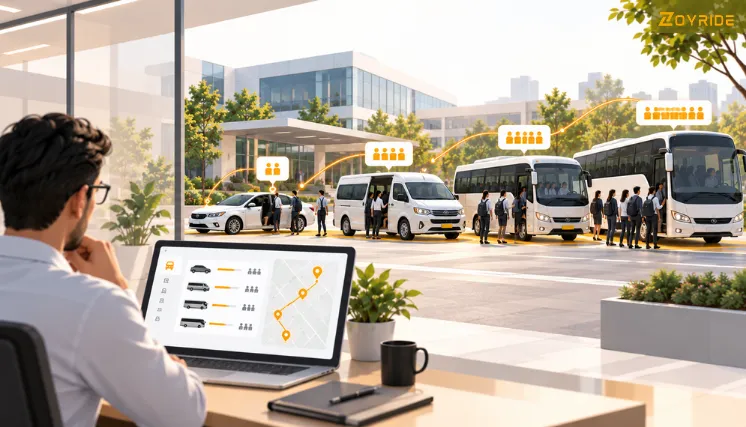
Getting vehicle capacity right is one of the practical challenges of managing employee transportation.
Too much capacity means vehicles may run with unused seats, increasing operating costs without improving the service. Too little capacity can lead to overcrowded vehicles, missed pickups, or employees having to wait for another trip.
Both problems often start with the same issue: capacity decisions are based on a fixed estimate instead of actual transport demand.
Employee transport capacity planning helps solve this by matching vehicle availability and capacity to the number of employees who actually need transportation across different routes, shifts, and locations.
For businesses managing multiple routes and vehicles, a transport platform such as Zoyride can help centralize the scheduling, vehicle, and trip information needed to make those decisions.
Start With Real Demand Data, Not Assumptions
The starting point for capacity planning should be actual ridership data.
Look at how many employees use each route, which shift they belong to, where pickups are concentrated, and how demand changes throughout the week.
For example, a route may have 40 employees assigned to it, but only 25 may use the service on a typical day. Others may be working remotely, using another transport option, or absent.
This is why registered employees and actual ridership shouldn’t automatically be treated as the same number.
With Zoyride’s employee transportation platform, teams can manage employee and trip information in a centralized system, making it easier to work with operational data when reviewing transportation requirements.
Map Transport Demand by Shift and Location
Looking only at total employee numbers can hide important differences.
One office may have a full 8 AM shift while another location has relatively low demand at the same time. Similarly, a night shift may require fewer vehicles but have different pickup requirements.
Effective vehicle capacity planning looks at demand by:
- Route
- Shift
- Pickup location or zone
- Day and time
- Vehicle capacity
- Actual trip usage
This can also reveal routes with similar pickup locations and timings. In some cases, combining or restructuring routes may allow available vehicle capacity to be used more efficiently.
Zoyride supports employee transport operations with scheduling, routing, vehicle management, and trip visibility, giving teams a centralized view of these operational factors.
Choose Vehicle Capacity Based on the Route
Using the same vehicle type for every route may seem simpler, but it doesn’t always make efficient use of available capacity.
A route with 10–12 regular passengers may not need the same vehicle as a route carrying 20 or more employees. At the same time, a route with highly variable demand may need some additional capacity to handle changes in attendance.
The objective isn’t to keep every vehicle completely full. It is to use a vehicle that is appropriate for the expected demand while leaving reasonable room for normal variations.
This is an important part of employee shuttle optimization because vehicle size directly affects how efficiently the available fleet is being used.
Keep Some Capacity for Demand Changes
Employee transport demand changes over time.
New employees join. Others leave. Offices move. Shift timings change. Attendance patterns vary. A route that worked well six months ago may no longer have the same demand.
That doesn’t mean every route needs a large spare capacity margin.
Instead, look at how much demand actually changes. A predictable route may require only a small buffer, while a route with significant fluctuations may need more flexibility.
The goal is to avoid two extremes:
Too little capacity: Employees may be left without a suitable transport option.
Too much capacity: Vehicles may operate with a large number of unused seats.
Measure Vehicle Utilization Regularly
Capacity planning doesn’t end when vehicles are assigned.
You also need to see how those vehicles are actually being used.
For example, a vehicle with 20 seats that consistently carries 8 passengers may indicate excess capacity. On the other hand, a vehicle regularly operating close to its maximum capacity may need a different vehicle assignment or additional capacity during certain shifts.
Vehicle utilization can be measured in several ways depending on the operation:
- Time-based utilization: How much of the vehicle’s available working time is spent serving trips.
- Capacity utilization: How much of the available passenger capacity is being used.
- Distance-based utilization: How much of the distance driven is associated with revenue-generating or scheduled trips.
Regularly reviewing these measures helps transport teams identify changes in demand before they become persistent operational problems.
Zoyride’s fleet and employee transport capabilities can help teams bring vehicle and trip information into the same operational workflow, making utilization easier to review alongside scheduling and dispatch data.
Use Software as the Operation Grows
A small employee transport operation can often manage capacity with spreadsheets and manual coordination.
The challenge grows when the operation includes multiple offices, shifts, routes, vehicles, and changing employee requirements. At that point, manually comparing employee demand with vehicle availability becomes increasingly difficult.
This is where employee transport software can help.
Zoyride provides tools for employee transportation management, including scheduling, route management, vehicle and driver management, GPS tracking, and operational visibility. By keeping this information in one platform, transport teams can spend less time maintaining separate records and more time reviewing where capacity needs to change.
For shuttle and bus operations, Zoyride also provides capabilities for managing scheduled transportation and vehicle capacity, helping operators manage passenger demand as part of their wider transport operation.
Turn Capacity Planning Into an Ongoing Process
The most important part of capacity planning is not choosing the right vehicle once. It is continuing to compare planned capacity with actual demand.
A useful review can ask:
- Are vehicles regularly running with many empty seats?
- Are particular shifts consistently close to capacity?
- Have employee numbers changed on specific routes?
- Are some routes showing lower demand than when they were created?
- Have new offices, shifts, or pickup zones changed transportation requirements?
These questions help teams adjust capacity based on what is actually happening rather than relying on assumptions made months earlier.
With Zoyride, transportation teams can manage employee transport operations and fleet information in one system, giving them a stronger operational foundation for making these adjustments.
Conclusion
Vehicle capacity should not be treated as a fixed decision.
Employee numbers, shift patterns, office locations, and transportation demand change over time. A vehicle allocation that worked well last year may create unused capacity or insufficient capacity today.
Effective employee transport capacity planning means regularly comparing actual demand with available vehicles, reviewing utilization, and adjusting transportation resources as the operation changes.
For businesses managing multiple employee transport routes, Zoyride provides a centralized platform for scheduling, routing, fleet management, and employee transportation operations, helping teams manage these changes more systematically.
See how Zoyride helps teams manage employee transport, routes, and vehicle capacity in one platform. View a Demo →
Frequently Asked Questions
What is employee transport capacity planning?
Employee transport capacity planning is the process of matching vehicles and available seats to actual employee transportation demand across routes, shifts, locations, and time periods.
Why is vehicle capacity planning important for employee transportation?
It helps businesses avoid having significantly more vehicle capacity than needed while also reducing the risk of insufficient capacity during busy shifts or periods of higher demand.
How often should employee transport capacity be reviewed?
Capacity should be reviewed whenever there are meaningful changes in employee numbers, office locations, shift timings, routes, or attendance patterns. Regular utilization reviews can also help identify gradual changes in demand.
What is the difference between vehicle capacity and vehicle utilization?
Vehicle capacity refers to how many passengers a vehicle can accommodate. Vehicle utilization looks at how much of that available capacity, time, or operational availability is actually being used.
Can employee transport capacity planning be managed without software?
Yes. Smaller operations can manage a limited number of routes and vehicles manually. As the operation grows, employee transport software can make scheduling, vehicle management, route coordination, and utilization tracking easier to manage from one system.