How AI Dispatch Reduces Fleet Operating Costs — What the Data Says in 2026
Discover how AI dispatch helps reduce fleet operating costs through smarter trip allocation, optimized routes, lower idle time, and improved operational efficiency.
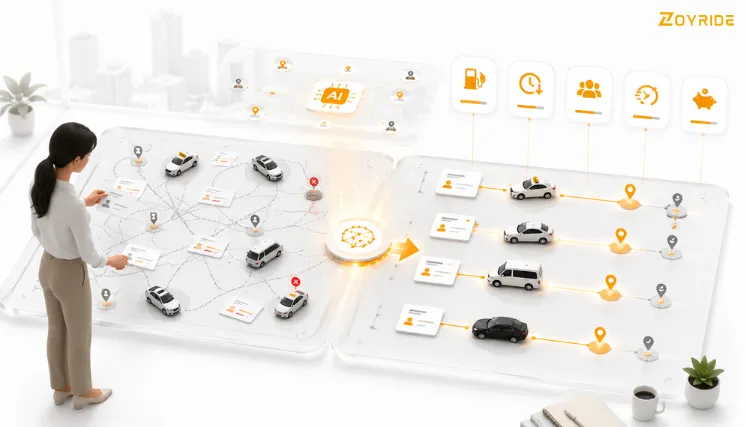
There is an invisible margin leak in most taxi and transport fleets. Every day, dispatchers manually decide which driver gets which trip, which route to take, and in what sequence. Each individual decision seems reasonable, but collectively, they leave significant revenue on the table.
This isn’t a failure of effort—it’s a gap in cognitive processing capacity. The variables involved in optimal trip assignment—live traffic, precise driver trajectory, vehicle load, trip chaining potential, and segment-by-segment fuel consumption—are simply beyond what any human can compute in real time across 20, 50, or 200 simultaneous trips.
Recent fleet industry data quantifies the cost of that processing gap. Deploying an ai taxi dispatch software platform consistently bridges it, producing measurable operating cost reductions across multiple verticals:
- 15–25% Lower Fuel Costs: Documented within the first 90 to 360 days of deployment.
- Up to 70% Reduction in Admin Time: Eliminates manual scheduling friction for coordinators.
- 10–25% Insurance Premium Savings: Driven by documented safety trajectories and AI driver monitoring.
Where Fleet Operating Costs Actually Concentrate
Before looking at what automation changes, it helps to analyze where operating expenses concentrate across taxi and transport operations:
- Fuel (35–40% of OpEx): The single largest variable expense in commercial fleet operations, driven primarily by inefficient routing and excessive engine idle time.
- Driver Wages & Unbillable Idle Time: Direct labor costs incurred during non-revenue waiting windows between assigned trips.
- Vehicle Maintenance & Wear: Accelerated component degradation caused by harsh driving habits, aggressive braking, and unoptimized mileage.
- Dispatch Administrative Time: Non-revenue operational overhead that scales linearly with fleet size when managed manually.
An integrated ai fleet management platform impacts all four cost drivers simultaneously, delivering broader operational savings than single-point software solutions.
What an AI Dispatch System Does Differently
The term “AI dispatch” represents several interconnected system capabilities working in sync.
1. Real-Time Optimal Assignment
Standard automated dispatch relies on simple proximity rules—assigning the closest available car. An ai dispatch system evaluates every available driver against live traffic vectors, heading angle, vehicle class, existing queue commitments, and trip chaining potential in seconds.
While a human dispatcher’s assignment accuracy degrades under heavy peak-hour volume, an automated system applies identical, optimal criteria whether handling the 1st or 500th booking of the day.
2. Dynamic AI Route Optimization Fleet Integration
Stop-and-go traffic increases vehicle fuel consumption by up to 40% compared to smooth travel. Static or daily pre-planned routes fail to account for mid-shift congestion.
Continuous ai route optimization fleet algorithms update dynamically, rerouting vehicles around incidents without dispatcher intervention. Medium-sized fleets save an average of 500–800 miles per week through dynamic routing, directly lowering fuel expenditure.
3. Smart Trip Chaining and Dead Mile Reduction
Dead miles—distance driven without a fare—represent unrecoverable operational loss. A smart dispatch system reduces dead miles by chaining trips intelligently:
| Dispatch Approach | Logic | Operational Result |
|---|---|---|
| Traditional Dispatch | Assigns the nearest available driver regardless of travel direction or upcoming demand. | Higher dead-mile ratio and increased fuel consumption. |
| AI Trip Chaining | Assigns the next pickup to the driver whose drop-off location aligns with predicted demand clusters. | Reduced idle time, lower empty miles, and more trips completed per shift. |
4. Driver Behavior Monitoring & Safety Impact
Fuel-efficient driving habits vary significantly across a fleet; research indicates up to a 38% variance in fuel consumption between drivers on identical routes due to acceleration, idling, and speed choices.
AI-driven telemetry surfaces these patterns, enabling targeted coaching. Furthermore, fleets implementing AI safety tracking experience up to a 73% reduction in crash rates over 30 months, unlocking carrier premium discounts of 10–25%.
How the Automated AI Dispatch Loop Works
- Booking Ingestion: Trip requests are captured instantly across all channels (mobile apps, web booking portals, or phone dispatch).
- AI Engine Evaluation: The platform simultaneously analyzes driver proximity, live traffic patterns, vehicle specs, and trip-chaining possibilities in milliseconds.
- Optimal Driver Push: The system assigns the trip to the highest-matching driver and dispatches turn-by-turn navigation directly to their device.
What Documented Fleet Deployments Show
Data from 2025–2026 fleet operations documents the following financial and operational outcomes:
- Fuel Reduction: 10–15% fuel savings within 90 days of deployment, scaling to 20–25% as driver routing compliance improves.
- Time to Positive ROI: 47% of fleet managers report full software ROI within 11 months, with fuel savings outpacing subscription costs in Quarter 1.
- Vehicle Utilization Rate: High-performing AI dispatch platforms elevate fleet utilization rates above 87%.
How AI Dispatch Transforms Taxi Operations Specifically
When applied specifically to passenger transport and taxi dispatch, an AI platform unlocks four core capabilities:
- Demand-Based Zone Balancing: Pre-positions drivers toward predicted demand clusters before bookings arrive, cutting pickup ETAs.
- Peak Period Load Handling: Maintains assignment speed and efficiency during traffic rushes without adding dispatcher headcount.
- Transfer Chaining: Automatically pairs inbound airport drop-offs with immediate outbound passenger pickups.
- Integrated Billing & Analytics: Directly connects dispatch execution to billing, driver payouts, and corporate SLA reports via an integrated ****Taxi Dispatch Software suite.
Deployment Requirements and Implementation Strategy
Upgrading to an AI-driven fleet model does not require rebuilding hardware infrastructure. Modern platforms connect directly to existing booking channels, passenger apps, and driver devices.
The fastest time-to-value occurs when operators approach deployment as an operational transformation: prioritizing driver app adoption, trusting automated assignment decisions, and regularly analyzing fleet data to refine operational parameters.
Final Thoughts
The financial justification for adopting AI dispatch technology is grounded in operational data. Leaving route choices and trip assignments to manual processing incurs avoidable fuel burn, administrative overhead, and vehicle idle time.
While driver behavior and local market conditions vary, deploying automated dispatch software systematically closes the processing gap—yielding direct operational savings from the first month of deployment.
Calculate Your Fleet’s Operational Savings
Upgrade your fleet operations with automated dispatch, live route optimization, and built-in fleet analytics.
Start your free trial | Talk to Our Mobility Specialists
Frequently Asked Questions
How much can AI dispatch software reduce fuel costs for a taxi fleet?
Documented deployments show 10–15% fuel savings within the first 90 days, scaling to 20–25% over 12 months as route compliance improves and dead-mile travel decreases.
What is the primary difference between AI dispatch and standard automated dispatch?
Standard automated dispatch assigns trips using static rules (e.g., nearest available driver). An AI dispatch system continuously evaluates multiple dynamic variables simultaneously—including live traffic, driver heading, trip chaining logic, and demand predictions—to make optimal assignments.
How quickly do fleets achieve positive ROI on AI fleet management systems?
Industry research indicates 47% of fleet managers reach full ROI within 11 months. In most operations, monthly fuel and administrative savings cover software licensing costs within the first 90 days.
Does AI dispatch work effectively for smaller fleets?
Yes. While larger fleets generate higher absolute dollar savings due to higher trip volumes, the percentage reduction in fuel, idle time, and administrative overhead remains consistent regardless of total fleet size.
What data inputs are required for an AI dispatch system to function?
The core inputs are real-time driver GPS locations, active booking streams, driver availability statuses, and mapping/traffic API integrations—data already present in most digital dispatch environments.