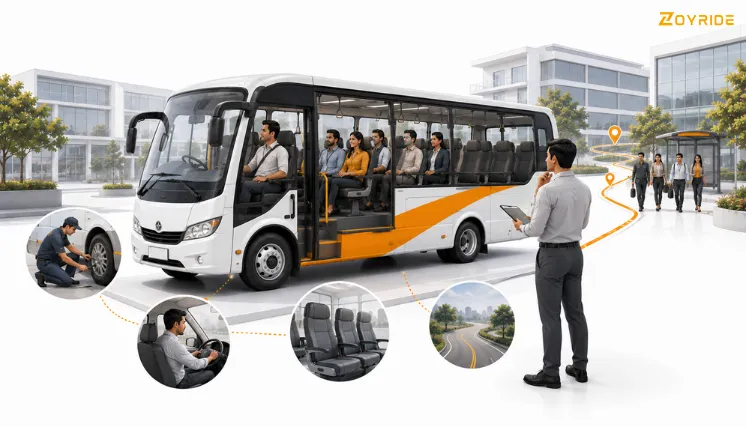
How to Calculate the Cost Per Passenger for an Employee Shuttle
Learn how to calculate the cost per passenger for an employee shuttle by factoring in vehicle, fuel, driver, maintenance, and other operating costs.

Running employee transportation can become expensive quickly. Companies pay for vehicles, drivers, fuel, maintenance, and other operating costs every month.
But knowing the total transport bill is only part of the picture.
A more useful question is: How much does it actually cost to transport one employee?
This is where cost per passenger helps. It gives transport and HR teams a simple way to understand whether their shuttle service is being used efficiently and where they may be able to reduce unnecessary spending.
What Does Cost Per Passenger Mean?
Cost per passenger is simply the amount your company spends to transport one employee.
The calculation is:
Total shuttle cost ÷ Number of passengers = Cost per passenger
For example, if a company spends $20,000 on employee transportation in a month and transports 500 employees, the cost is:
$20,000 ÷ 500 = $40 per passenger
That’s it.
The important part is making sure you use the right numbers.
What Should You Include in the Cost?
Start with the main expenses involved in running your employee shuttle service.
These may include:
- Vehicle costs
- Driver costs
- Fuel
- Maintenance
- Tolls and parking
- Insurance
- Transport management software
- Other operating expenses
You don’t necessarily need a complicated calculation. The goal is to get a realistic picture of what the company is spending to provide transportation.
Use Actual Passengers, Not Just Registered Employees
This is where many companies can get misleading results.
Suppose 1,000 employees are registered for your shuttle service. That doesn’t mean all 1,000 employees use it every month.
If only 600 employees actually travel, your calculation should use those 600 passengers.
For example:
Monthly transport cost: $30,000
Actual passengers: 600
$30,000 ÷ 600 = $50 per passenger
If you divided the cost by all 1,000 registered employees, the result would be $30, which makes the service look cheaper than it actually is.
Using actual passenger numbers gives you a more realistic view.
Why Does This Number Matter?
Cost per passenger becomes useful when you start comparing different routes and vehicles.
For example, imagine two shuttle routes cost the same to operate.
Route A carries 30 employees.
Route B carries 10 employees.
Even though both routes cost the company the same amount, Route B is costing more per passenger because fewer employees are using it.
This doesn’t automatically mean Route B should be cancelled.
There may be employees who need the route, or the route may serve a location where other transportation isn’t practical.
Instead, the number tells you that the route deserves a closer look.
Look at Your Routes
Your average cost across the entire employee transport operation may look reasonable while a few individual routes are costing much more.
That’s why it’s useful to check:
- Which routes have the most passengers?
- Which routes have empty seats?
- Which vehicles are regularly underused?
- Are multiple routes covering similar areas?
- Are some trips running with very few passengers?
You may discover that the problem isn’t the total transportation budget. It may simply be that some vehicles or routes aren’t being used efficiently.
Empty Seats Can Increase Your Cost
One of the easiest ways to understand transport efficiency is to look at empty seats.
Imagine a 40-seat vehicle regularly carries only 10 employees.
The company is still paying to operate that vehicle, even though most of its capacity isn’t being used.
If another vehicle could serve the same employees, or if two routes could be combined, the company might be able to reduce unnecessary operating costs.
This is why employee transport optimization isn’t always about reducing the number of employees using the service. It’s often about making better use of the vehicles already running.
Make Sure Your Vehicle Matches Demand
The size of your vehicle also affects transportation costs.
A large vehicle may make sense for a busy route during peak hours. But using the same vehicle for a route with only a few passengers may not be the most practical option.
Transport teams should regularly ask:
Are we using the right vehicle for the number of people traveling?
If passenger demand has changed, vehicle allocation may need to change too.
Check Your Numbers Regularly
Employee transportation needs don’t stay the same forever.
People change shifts. Employees join or leave the company. Offices move. Work schedules change.
A route that worked well six months ago may now have many empty seats.
That’s why companies should review their transportation data regularly rather than relying on old route plans.
Even a simple monthly review can help identify:
- Low-use routes
- Frequently full routes
- Underused vehicles
- Changes in passenger demand
- Opportunities to combine trips
How Technology Can Make This Easier
Doing all of this manually can become difficult when a company manages many employees, vehicles, and routes.
An employee transport management system can bring booking, route, vehicle, and passenger information into one place.
Instead of estimating how many employees use each route, transport teams can use actual booking and trip data to understand what’s happening.
This makes it easier to identify underused vehicles, monitor occupancy, and make better decisions about routes and schedules.
For larger organizations, having this information available in one system can make corporate transport optimization much easier.
A Simple Way to Review Your Shuttle Costs
You don’t need a complicated formula to start.
Follow these three steps:
1. Find your total transport cost.
Add the main costs involved in operating your employee shuttle service.
2. Find your actual passenger count.
Use the number of employees who actually used the service.
3. Divide the two numbers.
Total transport cost ÷ Actual passengers = Cost per passenger
Then compare the result across different routes and months.
The goal isn’t necessarily to achieve the lowest possible number. It’s to understand where your money is going and whether you’re getting good use from the transportation you’re providing.
Conclusion
Knowing your total employee transportation cost is useful, but knowing the cost per passenger gives you a clearer picture of how efficiently your shuttle service is operating.
A simple calculation can help you spot routes with low usage, vehicles with too many empty seats, and areas where schedules or vehicle allocation may need to change.
You don’t always need to cut transportation to reduce costs. Sometimes, small changes to routes, vehicle allocation, and scheduling can make a significant difference.
Want to see how technology can simplify employee transportation management?
View a Demo of Zoyride and explore how you can manage employee transport, routes, bookings, and fleet operations from one platform.
Frequently Asked Questions
How do I calculate employee shuttle cost per passenger?
Divide your total shuttle operating cost by the number of employees who actually used the service. For example, $20,000 in monthly costs divided by 500 passengers equals $40 per passenger.
Should I use the number of registered employees?
It’s better to use actual passengers whenever possible. Registered employees may not use the shuttle every day, so using actual usage gives you a more accurate result.
What if some routes have very few passengers?
Don’t immediately remove them. First check why the route has low usage and whether you can adjust the vehicle, schedule, or route.
How can companies reduce employee shuttle costs?
Companies can look for underused vehicles, empty seats, overlapping routes, and schedules that don’t match employee demand. Improving how existing vehicles are used can reduce unnecessary costs without removing important transportation services.
How can software help with employee transport costs?
Transport software can help you track bookings, passengers, routes, vehicles, and trip activity in one place. This makes it easier to understand where transportation resources are being used and where improvements may be possible.